We have been quiet, on purpose.
For the past few months, we have been heads down building towards something bigger, and we are excited to reveal where we have landed.
Credit has always carried the same promise: the freedom to act before the money catches up, to do more than your current balance allows, to move on your own terms. It is the thing that gives people and businesses real agency in the financial system, and yet the infrastructure behind it has barely changed in 30 years. Terms are rigid because the technology is rigid, rates are expensive because the plumbing is expensive. The promise was real, but the engine behind it was not.
We have already seen what happens when you rebuild financial architecture from scratch. Stablecoins did it for payments, and overnight they became programmable, global, and structurally cheaper. That same transformation is now possible for credit, and almost nobody is building it.
Sprinter has been focussed on credit for a while, but we started by solving a different problem. We set out to make crosschain transactions seamless, built solver infrastructure, and it worked. The next step was to take it beyond the solver use-case, and the deeper we went into how people and applications actually move value, the more we kept running into the same gap. Every path eventually led back to credit: the missing layer, the primitive that nobody had built yet, and the one that would unlock the most value if someone did.
And so we got to work.
Today we are showing you the first piece of this makeover. A new Sprinter, enhanced from the ground up with new infrastructure, a new identity, and a new level of ambition. All driven by a single conviction.

Credit runs on Sprinter.
This is not just a cosmetic rebrand, it reflects a fundamental shift in what Sprinter is and where we are going.
We are a credit engine. Any application, whether they are building for consumers, businesses, or autonomous agents, can plug in via a single API and offer credit that actually works. That means flexible terms instead of one-size-fits-all, adaptive risk management instead of static rules, and economics that benefit the borrower because the collateral backing every credit line is productive, generating yield that makes credit cheaper by design.
The complexity stays under the hood, and the end user just gets better credit.
The new brand is just the beginning. Over the coming weeks, we will be sharing what we have been building behind the scenes, including a major upgrade to our core infrastructure and something entirely new for consumers.
We are not ready to say more just yet. But if you believe credit is the next great layer of finance to be rebuilt, and that the team that builds the engine will define how it works, then you will want to pay attention to what comes next.
Explore the new Sprinter, and stay tuned for what’s next.
Stay updated on all things Sprinter, and onchain credit, by following us on X, joining our Telegram, and reading more on our blog.
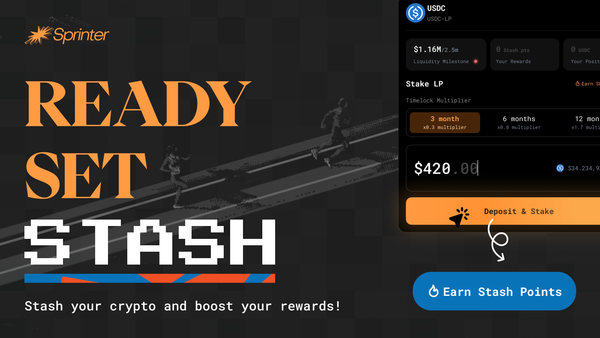
Sprinter Stash’s app will officially go live tomorrow at 12pm CET, unlocking a new way for DeFi participants to earn rewards by contributing USDC liquidity to Sprinter Stash.
But this isn’t just about staking and waiting. It’s a chance to be part of the next wave of crosschain liquidity infrastructure — and earn real rewards for doing so. For those who jump in early, the benefits get even better.
Sprinter Stash is a dynamic liquidity layer designed to power crosschain execution within the Sprinter protocol. Liquidity providers deposit USDC into the protocol through an intuitive interface, selecting the chain they want to deposit from and locking their funds for a chosen duration.
Once deposited, Stash takes over, algorithmically distributing and rebalancing liquidity across supported chains based on live solver demand. This allows solvers to borrow credit on destination chains without collateral, enabling instant, capital-efficient execution across the ecosystem.
When a transaction is filled, the borrowed funds are repaid on the source chain. From there, profits flow back to LPs, who earn from a combination of solver fees, passive yield, and Stash points.
It’s liquidity that works harder — and smarter.
When Stash goes live tomorrow, the race to rewards begins! We will be kicking off a series of events as part of the Sprinter Olympics, where you can earn Stash Points, a new rewards system that tracks your contributions across the Sprinter ecosystem.
The first event will be The 100M Stash, where you can earn Stash Points by depositing USDC into Sprinter Stash and locking your liquidity for a chosen duration. Stash points will be distributed 1:1, for every $1 staked, you receive 1 Stash point.
More ways to earn will be revealed in the coming weeks, in addition to the leaderboard going live soon - so keep stacking points and we’ll see who’s leading the race.
Sprinter Stash rewards liquidity providers with points, and yield that scales based on how long you lock your funds. The longer you commit, the higher your multiplier, starting at 0.4x for a 3-month lock, up to a generous 2.2x for a 12-month commitment.
And for early adopters, there’s an additional reason to act fast: deposits made within the first 48 hours of each milestone unlock a 100% SPRNT bonus on your USDC deposit, on top of your regular rewards. No extra steps required — just show up early, and your bonus will be automatically applied.
To kick things off, we’re rewarding our earliest Stashers with both base multipliers and bonus points.
Base Multipliers
Lock your liquidity and earn more Stash points based on your commitment:
Bonus rewards (First 48 Hours)
Deposit USDC in the first 48 hours of each milestone and you’ll receive a 100% bonus on your USDC deposit, in Stash points — no extra steps needed.
Sprinter Stash gives LPs access to dynamic, multichain rewards - powered by solver activity and protocol incentives.
Here’s how it flows:
You earn from:
Sprinter Stash goes live at 12pm CET, tomorrow Thursday 13th November. The early bird count down starts then. Staking early means maximizing your rewards, both with boosted multipliers and exclusive bonus rewards for early birds.
Connect your wallet. Multiply your rewards. Power the future of crosschain DeFi.
The Sprint has officially begun 🏁
Join the Sprint and follow us on X, joining our Telegram, and reading more on our website.
Going live later this week, Sprinter Stash welcomes a new era of credit and sustainable yield for decentralized finance.
The next frontier in crypto is credit. While stablecoins, tokenization and DeFi brought trillions of USD in assets on chain, market efficiency and UX still lack behind.
Sprinter Stash is a new onchain credit protocol that powers the next-generation of use cases, from solver credit lines to trading, whilst rewarding LPs with sustainable, risk-managed stablecoin yield. Stash provides zero-collateral credit, so solvers don’t need capital, users don’t need to touch bridges, and dApps get instant fills.
Our first supported venues: Intent protocols and wallets. But this is just the beginning.
As DeFi has evolved toward intent-based architecture and crosschain composability, a new class of infrastructure actors, solvers, has emerged. Solvers translate user intent into action, often across multiple chains and assets. But their growth is being stifled by one persistent bottleneck: capital.
While protocols may be decentralized in architecture, the execution layer remains heavily centralized, controlled by a small number of entities that have the liquidity, operational scale, and risk infrastructure to operate effectively.
The Result?
At the core of the problem lies the cost, access, and management of the required capital crosschain. Solvers must not only source capital across multiple chains, but also manage inventory risk, price volatility, and bridge friction—all before earning any return.
More specifically:
While leading market makers have already built the required crosschain infrastructure, the majority of the market still lacks access to these capabilities.
Unlocking shared, risk-managed liquidity will not only broaden participation but also increase resilience, decentralization, and innovation across the DeFi stack.
Sprinter Stash is a credit-based liquidity protocol that connects stablecoin LPs with crosschain actors like solvers and strategists and bridges the gap between passive capital and high-frequency, crosschain demand.
By bridging the gap between capital and execution, Sprinter Stash enhances liquidity efficiency, reduces fragmentation, and accelerates DeFi adoption. Stash’s native chain will be BASE, with satellite pools on every other chain.
Sprinter Stash is for liquidity providers looking for an attractive yield opportunity based on a new DeFi primitive:
Sprinter Stash enables capital-efficient crosschain execution by removing the need for pre-funded liquidity pools or collateralized loans. Liquidity is automatically managed across chains via a variety of rebalancing and netting protocols. At launch, Stash initially supports solvers filling orders in:
Solvers can use Stash credit lines to borrow and fill — creating faster, more competitive intent execution. Sprinter Stash credit is designed to scale beyond solving itself. Over the next weeks and months, we’ll expand credit and collateral types to further increase efficiency in DeFi for traders, Portfolio Managers and Strategists.
By bringing together liquidity providers and solvers Sprinter Stash creates a more efficient and scalable solver environment for the entire DeFi ecosystem. Stash launches with supported:
Crypto’s next evolution depends on seamless liquidity movement across chains. Sprinter Stash isn’t just another liquidity protocol, it’s a credit layer that makes crosschain transactions faster, more capital-efficient, and scalable.
With low-risk, high-reward liquidity pools for LPs and zero-collateral liquidity access for solvers, Sprinter Stash is reshaping the way liquidity moves in DeFi and beyond.
Stash goes live later this week, stay updated on how you can participate, and how you can earn rewards by following us on X, joining our Telegram, and reading more on our website.
Join us to shape the future of onchain credit.
📬 Are you building a solver, PM system, or DeFi infra that needs crosschain liquidity? Reach out to us on X or Telegram. We’re onboarding early partners now.

User experience (UX) plays a critical role in attracting and retaining users. Today, the blockchain space is facing a crucial challenge: complex UX across multiple chains that hinders the adoption of decentralized applications (dapps).
As new technologies and account options grow, people are finding it harder to manage their assets and deal with complicated transactions. To achieve mainstream adoption, blockchain applications must become far simpler and completely intuitive. They should provide a straightforward, smooth experience that gets rid of the current technical difficulties that scare away new users.
Sprinter is an interoperable solver engine for chain abstraction providers. Sprinter allows dapp developers to support various account types across a multichain ecosystem. The underlying transactions are swift and seamless, giving your end user a single-click experience when enacting otherwise complex transactions. Sprinter is developed by the team behind the Sygma cross-chain connectivity protocol.
Sprinter isn’t a lock-in service—far from it. We support multiple wallet types and chain abstraction solutions so any blockchain-enabled app can provide the intuitive user experiences people expect.
As methods for chain abstraction—the “coverup” of complex blockchain processes—proliferate in the web3 space, we’re working to improve the application level that matters most to users and fuels web3 adoption. We're building a web3 where users don't need to know any technical details to use multi-chain applications.
If a user wants to use your app but has their assets somewhere else, Sprinter will go get them. Sprinter solves the “cold start” problem of decentralized applications and games by making user funds on other chains immediately available for use.
Sprinter provides just-in-time (JIT) liquidity and bears the equivocation risk in transactions. Integrating Sprinter helps you build cross-chain applications that achieve the UX people expect, improving capital efficiency for you while your users save time and money.
The blockchain space is at a critical juncture: improve now, or face a restart cycle.
Challenging adoption from day one is blockchain’s UX problem. The early days are forgivable, most early-adopters were tech literate and unlikely to shy away from ugly applications or a completely manual user experience. Closing this chapter is the ultimate goal of chain abstraction.
Most people aren’t like blockchain technology's early adopters. Most people are afraid of their PC’s command prompt. Chain abstraction solutions seek to solve much of blockchain's complexity through minimizing user decision-making, reducing interface complexity, and improving transaction reliability across chains.
Our CPO, Greg Markou went to EthCC 2024 to talk about this new wave in web3 development. Watch the presentation below.

Usability is the most important factor developers need to improve if web3 is going to achieve mainstream adoption. One of the leading reasons people choose to enter cryptocurrency markets today is its ease of use compared to legacy markets. According to a Forbes (from the Forbes Advisor Survey conducted in the UK), 42% of respondents said they entered the cryptocurrency market because it’s easier to invest through an app.
Contrasting this, the number of unique, active addresses on Ethereum lacked significant growth between 2023 and 2024 (etherscan.io).
In 2022, the rise of L2 solutions fueled growth in the Ethereum ecosystem. In 2024, blockchain developers are zeroing in on UX. By creating solutions that leverage the vast, multichain ecosystem of today and embracing non-crypto natives, we can supercharge our industry's growth going forward.
Blockchain application adoption, at the current level of usability, is difficult. We need to expand user bases across chains and across demographics. Our blockchain-powered apps need to be far, far simpler to use.
In 2022, L2s pushed blockchain growth. Today, rollups are poised to shape the future—L1 scalability is dependent on their ability to bundle and compress multiple (up to/over one-million daily by ZkSync’s numbers) transactions before posting to the L1 blockchain.
— ZKsync (∎, ∆) (@zksync) March 27, 2023
The flip side to these solutions is a dramatic increase in fragmentation. Each new rollup (launching practically every week) and each new EIP-4337 wallet increase the disparity of funds and accounts across the multichain ecosystem.
These EIPs focus on how wallets interact with the application layer and tie back into chain-agnostic protocols.
The big game-changer for web3 applications is EIP-7715:
Designing apps from the perspective of user intentions helps us to decide what and how much a user should be interacting with. As an interoperable solver engine, Sprinter makes user intents achievable while demanding the least amount of user interaction possible. For intent-based design, the UX principle “don’t make me think” is paramount.
For example:
A DeFi user’s intent is to “make at least 10% on my ETH holdings”.
The methods available to solve this intent are mostly irrelevant—the user doesn’t usually care how their intention is achieved.
There are multiple complexities underlying the intent: cross-chain calls, multiple transactions, liquidity issues, and potential slippage. Beyond this, there’s a risk for “bricked” states where transactions only partly execute across chains.
Sprinter is an interoperable solver engine—it takes intents generated by users, protocols, and front ends and solves them with best execution path.
This example shows how Sprinter unifies balances from three different source chains (Chain A, B and C in the top left) and solves the user's intent—to transact on a new, fourth chain (Chain D, top right).
Sprinter is a fresh release, but we’re already integrating into some major projects in B3 and DELV’s Hyperdrive.

B3 is the horizontal, multi-L2, web3 gaming platform launching on Base. Their mission is to bring web3 gaming to the level of usability that today’s gamers expect—and that’s why Sprinter is the perfect fit for their tech stack. Games hosted on B3 will never have to grapple with a cold start and early drop-offs due disparate user funds.
Sprinter makes sure every player can access their balance across chains, and across games, and right away.
“We’re very excited to collaborate on building a gaming ecosystem that from day one caters to the needs of web2 gaming companies, not just a generalized blockchain. That is fundamentally important: chain abstraction has come a long way in the last year, and we can scale an ecosystem horizontally while maintaining incredible web2 UX.” - Greg Markou, CPO, ChainSafe Systems

Just like ChainSafe, DELV is a champion of open-source software. Hyperdrive is an Automatic Market Maker (AMM) protocol for fixed-rate markets, using assets from yield sources to create tradable tokens. These tokens are bought at a discount and redeemed at full value at maturity, offering a fixed return.
Sprinter greases Hyperdrive’s wheels by letting users take advantage of their platform immediately, avoiding every blockchain app’s first critical drop-off point: onboarding.
"Our users might have their assets on multiple chains—in DeFi, it’s common to have assets on mainnet, OP, ARB, BASE...so we needed a way for users to easily and efficiently bring the assets they need to one chain in the most efficient way possible. That is: cheap, fast, and in a single transaction." - DELV team
Here’s a look ahead at our vision for Sprinter V2:
Set your application apart and embrace the multichain ecosystem.
“Sygma has not only empowered our blockchain capabilities but has also solidified trust within our community.” - Phala Network
The Phala Network is a blockchain protocol that centers on trust and security in cloud computing. Users can contribute computer processing power, stake tokens to secure the network, and bridge tokens to and from the Phala Network through SubBridge.
Interoperability and ecosystem growth are central tenets of the Phala Network. Phala is a Polkadot L1 parachain that has issued tokens natively (PHA), on Ethereum (ERC-20 PHA), and Kusama (Khala PHA).
Phala won parachain auctions for Kusama and Polkadot in 2021 and 2022, respectively. The mainnet is built using Substrate, a modular blockchain development framework developed by Parity Technologies.
After winning their parachain auction slots, Phala Network decided to enhance token liquidity by migrating ERC-20 PHA to the Polkadot ecosystem. The mainnet launch came with a grab-bag of problems to address:
The Polkadot ecosystem continues to face liquidity issues, requiring secure and efficient transference in and out of Polkadot/Kusama and their parachains. Liquidity issues can stem from various factors:
Interoperability challenges
Polkadot aims to enable interoperability among blockchains, including parachains and external networks. Developing and optimizing interoperability solutions and bridges is crucial for efficient asset transfers and trading between chains.
Relative newness
Polkadot/Kusama is a relatively new blockchain network. Compared to more liquid environments, many projects in Polkadot are in the early stages of development.
Limited exchange support & isolation
While Polkadot/Kusama and its parachains have seen increased exchange support, token liquidity pales compared to more established networks. Additionally, while parachains are interoperable within their network, Dotsama is somewhat siloed against the larger blockchain environment.

Phala planned development for SubBridge to connect their network to blockchains outside the Polkadot/Kusama parachain network. Powering the bridge itself was ChainBridge, an earlier product originally developed by ChainSafe. Later, ChainBridge would provide the basis for developing Sygma.
The Sygma team, in collaboration with Phala Network, developed the Substrate pallets to power SubBridge.
SubBridge is a first-of-its-kind interoperability solution developed by Phala Network to secure and efficiently transfer assets and data between different blockchain networks. At its core, SubBridge is a router linking different cross-chain bridges to other registered chains.
The upgrade to Sygma dramatically reduced SubBridge's transaction costs. Where the earlier version of SubBridge relied on multiple voters to confirm cross-chain transactions, Sygma’s MPC-based relayer could perform the same action through a single transaction.
Sygma has passed audits from KALOS, Least Authority and Veridise. Sygma has resolved all vulnerabilities and concerns raised by the audits.

Sygma has not only empowered our blockchain capabilities but has also solidified trust within our community. We are proud to partner with a team that stands at the forefront of blockchain interoperability solutions.” - Phala Network
August 29, 2022: Phala Network successfully transfers 38 million PHA from Ethereum into the SubBridge smart contract.
#PhalaANN
— Phala Network (@PhalaNetwork) August 30, 2022
🔊 The Phala team completed a migration that contained 38million $PHA (the remaining token for parachain slot auctions) from Ethereum to Phala’s smart contract bridge - https://t.co/hy3IXJVyag on August 29th, 2022 (SGT).
✨ Learn morehttps://t.co/ChSR6QrNzx
September 1, 2022: SubBridge two-way transfers go live to all users, allowing them to swap PHA and Khala PHA for ERC-20 PHA at 1:1.
December 12, 2023: Phala initiates a second massive liquidity transfer from ChainBridge into Sygma’s smart contracts.
🔔 $PHA liquidity is moving from ChainBridge to Sygma Bridge! @buildwithsygma
— Phala Network (@PhalaNetwork) December 12, 2023
This transition brings enhanced efficiency & UX. After six smooth months on #SubBridge, we're set for the next phase ✨
The volume of tokens being transferred:
1️⃣ Khala: 567,411,080.628198082714
2️⃣…
SubBridge, powered by Sygma, connects Phala and other Polkadot/Kusama parachains to a vast market of potential customers and liquidity from Ethereum and other registered blockchains.
From a macro perspective, SubBridge also permits the seamless two-way motion of liquidity into Polkadot/Kusama. While applications on Polkadot are maturing, integrating Sygma’s cross-chain asset and data transfer solution can prime those applications for growth.
Today, Sygma supports over 140 million USD in total locked value via Phala Network.
“Utilizing Sygma as our bridge solution has been a game-changer for Phala Network. It has flawlessly facilitated over 100 million USD in cross-chain transactions, showcasing unparalleled reliability and efficiency." - Phala Network

SubBridge can transfer assets and data across multiple sources and destinations. SubBridge allows users and developers to bridge from EVM into a Substrate chain (e.g. Phala). From there, using the underlying XCM protocol inherent within Substrate-based chains à la Polkadot/Kusama, it's possible that SubBridge can route your asset to a different parachain.
The video above demonstrates Sygma’s proof-of-concept with the PHA token transferring from EVM to PHA to Astar, its end destination.
SubBridge functionality relies on Sygma, an open-source interoperability protocol that connects various blockchain networks. Through Sygma, SubBridge establishes connections between Phala Network and its interconnected chains, allowing users to transfer assets and data across these platforms with minimal friction and fees.
Validators: Validators play a pivotal role in ensuring the integrity and security of transactions on SubBridge. These validators are responsible for validating and verifying the legitimacy of cross-chain transactions, thereby preventing potential exploits or fraudulent activities.
Relayers: Relayers are intermediaries for transferring messages and transactions between blockchain networks. They relay information between Phala Network and other interconnected chains, ensuring seamless interoperability.
Bridge Pallets and Contracts: Bridge contracts act as smart contracts deployed on Phala Network and the EVM. These contracts enforce the rules and conditions of cross-chain transactions, ensuring transparency and reliability throughout the process.
Initiation: The cross-chain transfer process begins when a user initiates a transaction on subbridge.io to transfer assets or data to another blockchain network.
Validation: Validators on both Phala Network and the target blockchain network verify the transaction's authenticity and legitimacy. This validation process ensures the integrity of the transaction and prevents double-spending or unauthorized transfers.
Relaying: Once the transaction is validated, relayers facilitate the transfer of assets or data from the Phala Network to the target blockchain network or vice versa. This process involves transmitting the relevant information across the bridge contracts (EVM) and pallets (Substrate) deployed on both networks.
Confirmation: Upon successful relay, the transaction is confirmed, and the transferred assets or data become accessible on the recipient blockchain network. Users receive confirmation notifications, assuring the completed transfer.
Visit us at buildwithsygma.com 🛠️
Sygma is the interoperability layer for building cross-chain applications. With Sygma, developers can leverage secure and efficient multi-bridge infrastructure to extend their applications beyond a single blockchain.
Next-generation composability and interoperability will provide applications with the needed features, such as swapping LP pairs across different networks. Whatever solution projects have in mind, Sygma gives you the power to quickly deploy the multi-chain infrastructure that lowers the barrier of entry for both developers and users.