CT systems: making remote collateral actually usable on perps
CT systems are not about printing money. They separate high-velocity internal activity from disciplined exits, keeping backing explicit. A design for perps

Remote collateral is one of those ideas that sounds obvious until you try to implement it: you want to trade on venue X, but your capital sits somewhere else (mainnet lending positions, vault shares, treasuries). Today the default solution is still basically “move the money,” which is safe but expensive: capital gets fragmented, buffers get duplicated, and “efficiency” ends up meaning leverage rather than better plumbing.I think Credit Token (CT) systems are a clean way to make remote collateral real without hand-waving.A CT system introduces an internal settlement asset — the Credit Token (CT) — that can be used for margin, fees, funding flows, and PnL inside a venue. The key design choice is that exits (CT → USDC) are handled under explicit redemption rules, rather than assuming everything must settle in USDC instantly. This gives you a clearer separation:
- high-velocity internal activity can run in CT units, and
- final settlement happens through a disciplined exit process.
Three properties that matter:
(1) CTs slow down “exit velocity”Inside the system, CTs can circulate quickly. But exiting to USDC happens through policy: redemptions are processed over a window with buffers sized to expected net exits + safety margin.Important nuance: this is not a fractional reserve. CTs are still backed by the system’s defined backing assets and controls. What’s “fractional” is only the amount of USDC kept immediately available for exits, not solvency.A useful mental model is to separate backing from exit liquidity: CTs outstanding can be fully backed, while the USDC sitting idle for immediate redemption is sized to net exit flow over a window (plus a buffer). The gap is covered by backing that stays productive until redemption is requested.
(2) CTs can create a “self-funding” loop via EarnIf users can deposit USDC into an Earn programme that funds the exit buffer, they can earn yield without giving up internal usability — because CTs carry velocity inside the venue. Instead of “either your USDC earns or it helps you trade,” it becomes closer to: your USDC can earn yield while CTs preserve your trading surface area.
(3) CT borrowing can price below USDC borrowing — for structural reasonsIn many systems, borrowing USDC forces someone to commit scarce, immediately redeemable liquidity. CT issuance doesn’t necessarily do that: CTs are fully backed, but the USDC needed for exits is managed as a liquidity buffer sized to net redemptions over a window. If internal flows largely net out and exits are predictable, the marginal cost of extending CT credit can be lower than sourcing and warehousing USDC liquidity at all times. In that case, the CT borrow rate can rationally sit below the prevailing USDC borrow rate. Not because the credit is “cheaper risk,” but because the settlement asset is internal and the liquidity constraint is different.
Example: With CTs + Earn, unified capital under one risk engine
In a CT-based venue with a USDC Earn programme, Alice can use her balance sheet more holistically, without juggling multiple protocols or splitting assets across multiple liquidation regimes.
Step 1 — Remote collateral → internal working capital.
Alice posts 1 BTC as remote collateral. After conservative haircuts and the venue’s risk policy, the system grants her a $35,000 credit line denominated in Credit Tokens (CTs). The venue mints 35,000 CT to her internal account.These CTs are her internal margin and settlement medium: she can open perp positions, pay funding, and realise PnL in CT units.
Step 2 — USDC stays liquid… or earns while funding exits.
Separately, Alice holds $20,000 USDC that is not posted as trading margin. She can choose to:
- deposit some or all into the venue’s Earn programme (earning yield while funding the USDC exit liquidity buffer used for CT→USDC redemptions), and/or
- keep some USDC in self-custody as dry powder.
From Alice’s perspective:
- BTC underwrites CT capacity and provides internal purchasing power for trading,
- CTs are the unit she uses for strategies and settlement inside the venue,
- USDC in Earn earns yield and helps fund exits — without requiring the venue to keep USDC idle against every outstanding CT.
Alice is effectively both a borrower (CTs issued against BTC) and a lender (USDC in Earn), under one coherent risk framework.
Why this matters specifically for perps
Perps are where remote collateral either becomes a real primitive or stays a slide. They compress everything into one place: margin, funding flows, fast mark-to-market, and liquidity constraints. If CTs are useful as “internal velocity with disciplined exits,” it should show up most clearly in perps.That’s why a venue like Lighter feels like a natural testbed: perps make the trade-offs visible, and they make the design falsifiable.
Questions I’d actually like to debate
If this framing is right, the interesting questions aren’t token mechanics — they’re market structure and risk policy:
- Where should CTs live: on the perp venue, in a clearing layer, or as a shared standard?
- What redemption rules feel acceptable to users while still giving the system real capital efficiency?
- What forms of remote collateral are tractable in practice (lending positions, vault shares, RWAs) without turning the risk engine into a monster?
CT systems aren’t about printing money. They’re about separating high-velocity internal activity from final settlement, while keeping backing explicit and exits disciplined.
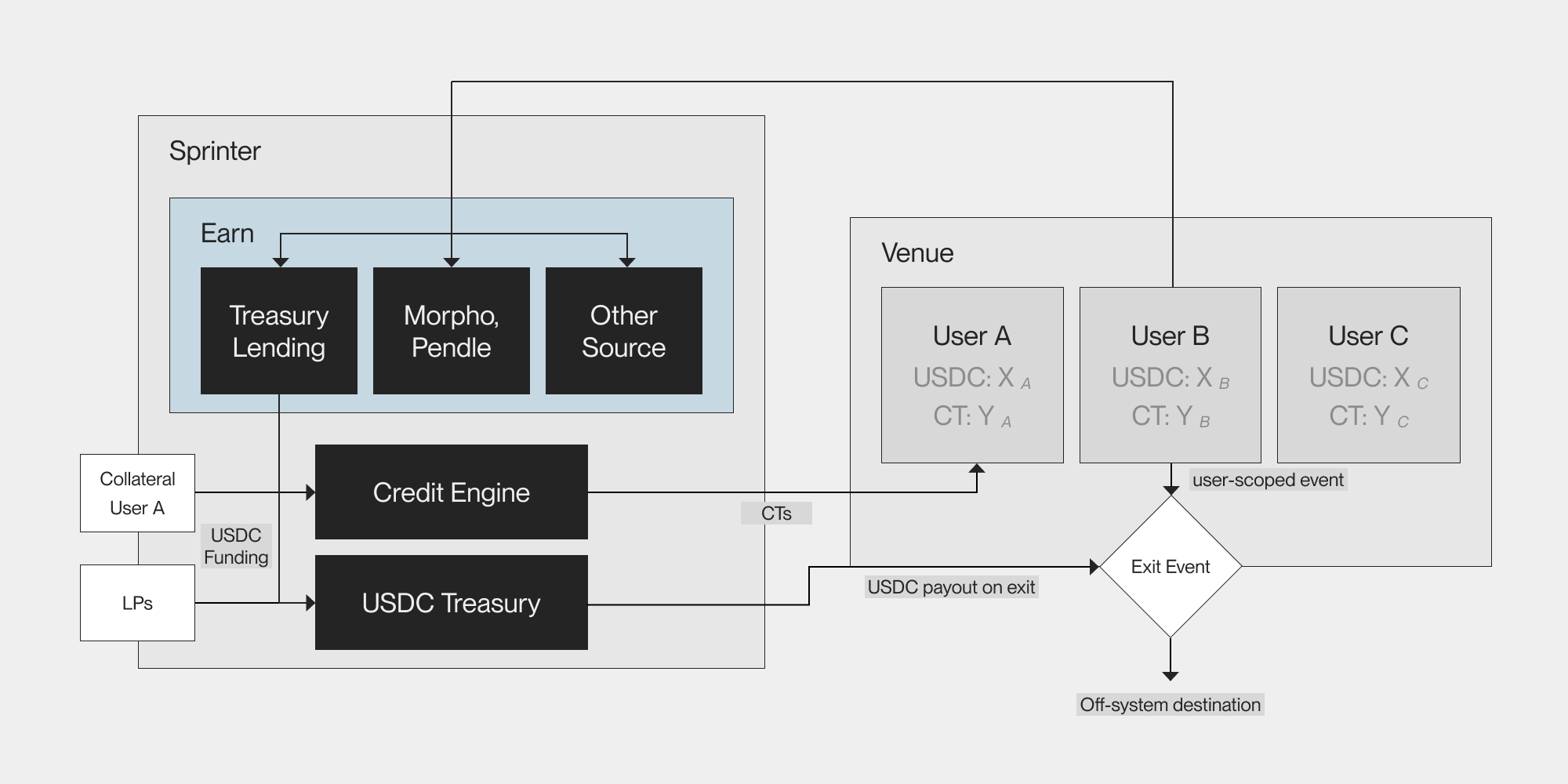
Schematic of a closed-system venue built around Credit Tokens (CTs)
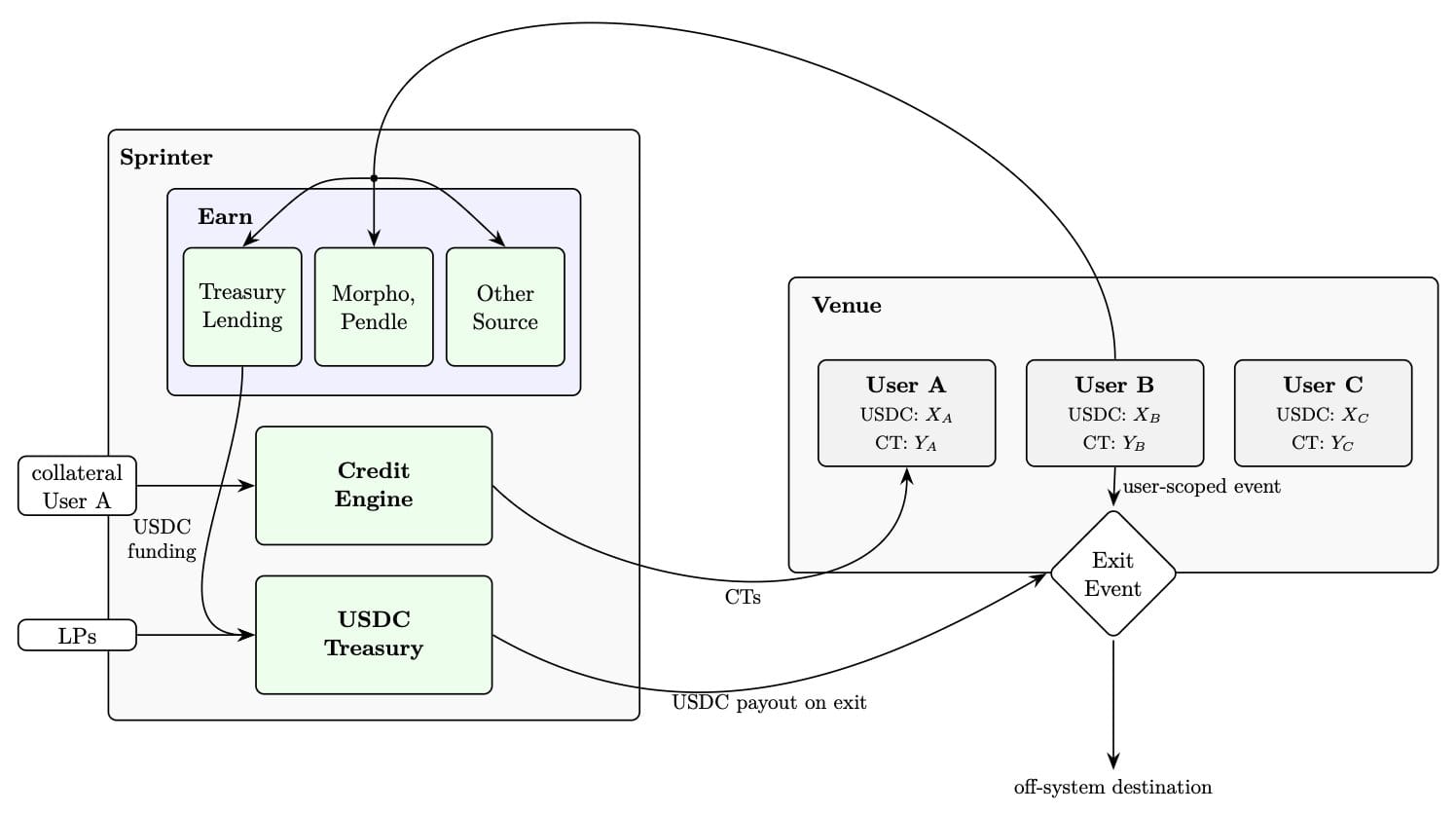
Users inside the venue hold trading assets and CT balances, where CTs act as the internal settlement unit and represent claims within the system. Remote collateral (e.g. BTC or ETH) is posted outside the venue but referenced by the venue’s credit and risk engine to determine how many CTs can be issued under haircuts, buffers, and (where applicable) hedging policy. In parallel, a separate set of users supplies USDC into an Earn programme. This USDC capital funds the venue’s exit liquidity buffer (and can be deployed to earn yield), and is used when CT holders trigger boundary events—most importantly CT→USDC redemptions (“exit events”) or other settlement operations that must occur in USDC.
Most activity—trading, margining, funding flows, and CT transfers—remains internal to the venue. This separation between high-velocity internal activity and managed boundary liquidity is what allows the same capital base to support remote-collateral trading and controlled redemption under a single, coherent risk framework. CTs remain backed by the system’s defined backing assets and controls; only instant USDC liquidity is managed as a buffer against net exits.
If you’re a venue and you want to explore “running on credit”, i.e., enabling remote collateral with a CT-based internal settlement layer and a managed USDC exit buffer: Sprinter can do this today. If you’re building a perp venue, a high-velocity trading system, or any system with internal/closed accounting and want to test credit-native settlement in production, reach out.