Prediction markets are not derivatives
Derivatives reference a process that evolves. Prediction markets reference an event waiting to resolve. That difference breaks all the hedging machinery.

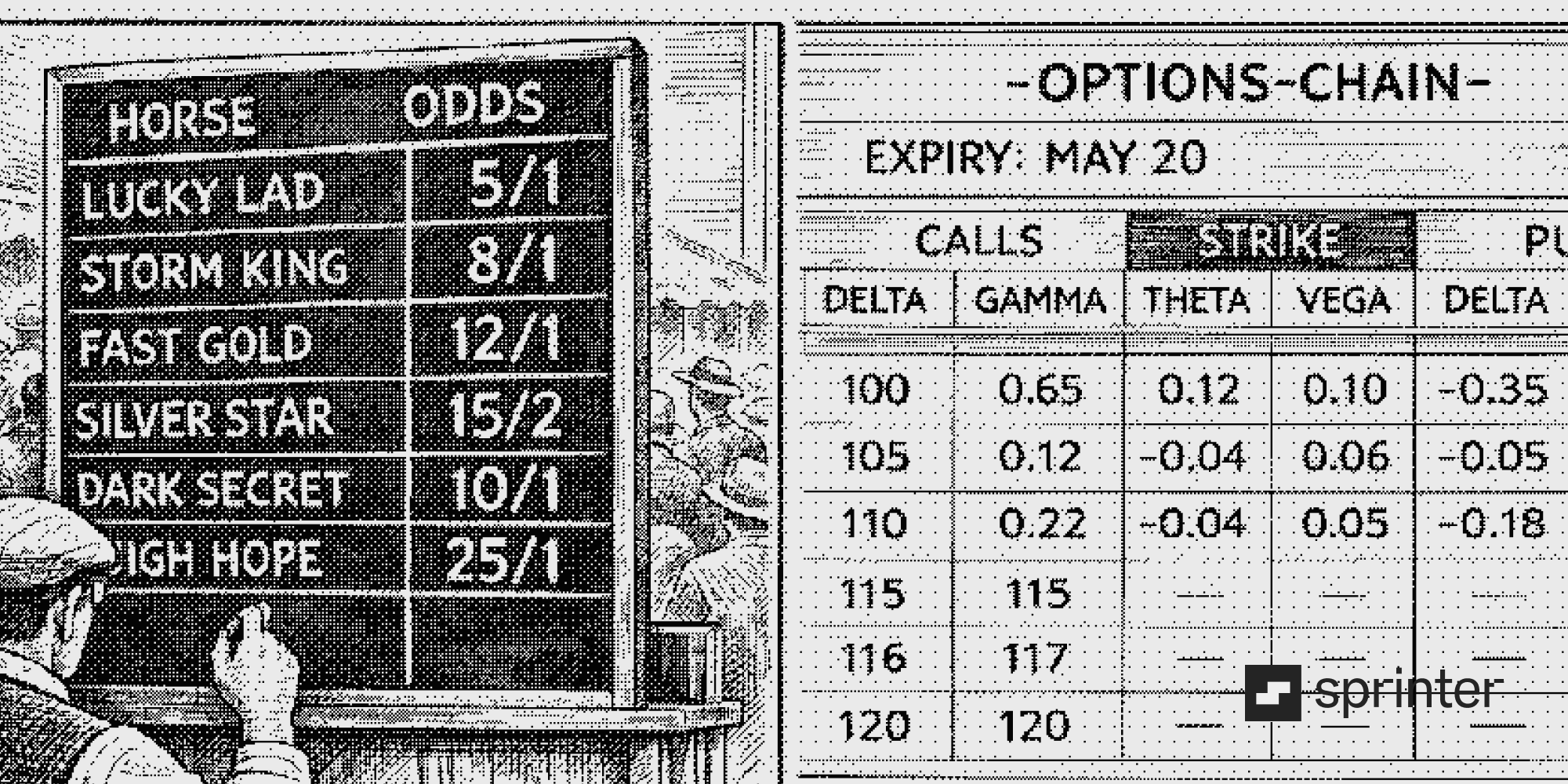
Prediction markets are increasingly discussed as though they belong in the same category as options, futures, and swaps. The language reinforces this: people talk about "pricing," "hedging," and "the Greeks" as if these concepts transfer cleanly. They don't.
The core difference is in the structure of the underlying. Derivatives reference a process that evolves and generates its own information. You can track it, trade against it, and hedge. Prediction markets reference an event that sits fixed, waiting to resolve. What evolves is the market's belief about the outcome, not the outcome itself. That distinction determines whether the pricing and hedging machinery of derivatives theory has any purchase.
What makes a derivative a derivative
An option on ETH has value because ETH exists as a tradeable asset. The option's price is pinned to ETH's price through arbitrage: if the option is mispriced relative to ETH, you can trade both simultaneously to lock in a risk-free profit. This is replication: constructing the option's payoff from the underlying plus financing at the risk-free rate.The entire machinery of derivatives pricing rests on this:
- An underlying you can trade. You can go long or short ETH at any time, in meaningful size.
- Replication. You can construct the derivative's payoff by dynamically trading the underlying. The initial cost of that replicating portfolio is the derivative's fair price.
- No-arbitrage. If the derivative's market price deviates from its replication cost, arbitrageurs close the gap. This is not a theory - it's an enforceable constraint.
Black-Scholes doesn't work because the math is elegant. It works because you can delta-hedge: hold the option, trade the underlying against it, and eliminate the directional risk. The price is what it costs to replicate the payoff. The hedging strategy is what enforces that price in the market.
Not all instruments classified as derivatives have perfectly tradeable underlyings. Weather derivatives and CDS on illiquid reference entities sit on a spectrum where replication is impractical to varying degrees. But in each case, the underlying is an observable quantity that evolves over time - temperature fluctuates, credit spreads move, hazard rates shift. These processes provide a theoretical anchor for pricing and give arbitrageurs a direction, even when they can't execute perfectly.
Prediction markets sit beyond this spectrum. The distinction is not just that you can't trade the underlying. It's that there is no underlying state process playing the role that an underlying plays in derivatives theory.
The underlying must be a process, not a revelation
ETH has a price process S_t with its own dynamics. In the simplest model:
dSₜ = μSₜdt + σSₜdWₜ
The price genuinely evolves driven by supply, demand, and market microstructure. At each moment, Sₜ generates new information about itself. The option payoff max(S_T - K, 0) depends on where this evolution ends up. You can track it in real time and hedge against it because the underlying is moving.
A Polymarket contract on "Will the Fed cut rates in June" references a different kind of object. The scheduled Fed decision is not a process - it's a single random variable X that resolves at a fixed time T (the FOMC announcement). What evolves is the market's belief pₜ = E[X | Fₜ], a conditional expectation that updates as information arrives (employment data, inflation prints, Fed speeches). But pₜ is the market learning about a fixed quantity, not tracking an evolving one.
More precisely: an option is priced against an underlying state process that evolves through time. A prediction market contract resolves on a fixed terminal random variable X, and the price at time t is the market's conditional expectation E[X | Fₜ] - the projection of that fixed outcome onto the information available now. What changes through time is not the underlying event itself, but the projection of that event onto the market's current information set. The information driving that projection comes from outside the event itself - economic data, news, speeches, and other public signals.
For derivatives, the underlying moves. For prediction markets, the underlying is revealed.This distinction handles the counterexamples that trip up simpler criteria. A CDS on corporate debt fits the derivative framework because the firm's credit state genuinely evolves: cash flows deplete, leverage changes, market conditions shift. Default is a stopping time of a real process. The hazard rate lambda_t is positive at every instant because default can happen at any moment. Weather derivatives reference temperature, which follows a continuous mean-reverting process with seasonal dynamics. In both cases, there is a process with non-trivial dynamics anchoring the price.
The boundary is not perfectly clean. Sovereign CDS sits in a grey zone: Argentina or Greece defaulting is partly a political decision - an "act of will" by this article's own taxonomy - not purely the terminal state of a deteriorating credit process. But the typical case supports the distinction, and the grey zone at the boundary doesn't invalidate the clear cases at the extremes.
A Fed rate decision, an election outcome, a court ruling, these are acts of will or judgement that resolve at a point in time. They don't evolve continuously. You can model your uncertainty about them as a process, but the uncertainty is yours, not theirs.
Why binary payoffs compound the problem
Some prediction markets reference a genuine price process. "ETH above $5,000 on December 31" on Polymarket depends on ETH's price, which does have continuous dynamics. ETH is tradeable on any number of exchanges. In principle, you could delta-hedge this position by trading ETH on Uniswap or Binance.But the binary payoff structure makes this hedge fragile even in theory. The payoff is a step function - discontinuous at the strike:f(ST)=1ST>5000 .
The delta of a binary option is well-behaved away from expiry, but as the contract approaches resolution near the strike, delta goes to infinity. In practice, traders on derivatives exchanges hedge digital options with call spreads (an approximation), not with the theoretical delta. The binary payoff structure means you can never hedge as cleanly as a vanilla option, regardless of how accessible the underlying is.
For prediction markets on events with no underlying process ("Will the Fed cut rates"), even this imperfect hedging is unavailable. You could compute a sensitivity to the underlying probability - highest near 50c, lowest near the extremes - but you can't trade "the probability." There is nothing to hedge against, not because of infrastructure limitations, but because the contract references a revelation, not a process.
Price is not probability
A YES share at $0.65 is commonly read as "the market says there's a 65% chance this happens." This is approximately right but importantly wrong. The price reflects the probability implied by marginal trading, distorted by forces that have nothing to do with the event's likelihood.
Some of these distortions are structural - they would persist even in a deep, liquid, well-functioning market:
Risk premium. A 90c YES share risks $0.90 to make $0.10. You need to be very confident to accept that asymmetry. This is one mechanism behind the well-documented favourite-longshot bias: high-probability events trade below their true probability, low-probability events trade above theirs.
Time value of capital. Capital locked in a prediction market contract earns no yield until resolution. A 95c YES share that resolves in 6 months competes with a 5% risk-free rate. Rational participants discount accordingly: the price reflects P(event) discounted by the opportunity cost of capital lockup. This is why near-certain long-dated contracts trade below their true probability.
Resolution risk. The price incorporates not just "will this happen" but "will this market resolve correctly." Oracle disputes, ambiguous resolution criteria, and edge cases all add a discount. Polymarket has had multiple controversial resolutions. Some markets push this further: "Will Zelensky wear a suit" is not really a bet on probability. It's a bet on whether a majority of observers will classify what he's wearing as a suit. The payoff depends on social consensus about a vague predicate, not on the realisation of a well-defined random variable.
Others are market-quality issues that better infrastructure could reduce but not eliminate:Liquidity premium. The displayed price is the top of book. Any meaningful position moves the price. Thin order books mean the "price" is more of a suggestion than a fact, especially in smaller markets.
The key difference from derivatives: in derivatives markets, these distortions are bounded by arbitrage. The option price can't deviate far from replication cost because arbitrageurs enforce convergence. In prediction markets, the structural distortions are the price. There is no external anchor to pull them back. Better liquidity helps at the margin, but the absence of a replicating portfolio is not a market maturity problem. It's a structural feature.
When prediction markets can hedge
There is a narrow exception, and it's worth being precise about it.If your economic exposure is mechanically determined by the binary outcome , not correlated with it, but caused by it. Then a prediction market contract is a legitimate hedge. The event and the exposure must be the same thing.Examples:
- A campaign vendor paid only if their candidate wins. Buying NO hedges the receivable.
- A protocol with a governance vote that, if passed, slashes your staked position. Buying YES offsets the loss.
- A contractor paid conditional on a regulatory approval. Buying NO hedges the revenue.
In each case, the binary payoff of the prediction market matches the binary structure of the exposure.
This breaks the moment you try to hedge a continuous exposure against a binary event with an unknown transmission mechanism. Buying YES on "SEC sues Coinbase" to hedge your ETH position is not a hedge in any rigorous sense. You don't know the hedge ratio. You don't know the transmission magnitude. You don't know whether the event will move ETH 2% or 20%. You have a correlated side bet, not a hedge.
What prediction markets actually are
If prediction markets are not derivatives, what are they?They are information markets. Their primary economic function is price discovery for probabilities. They aggregate dispersed private beliefs into a single public signal, analogous to how equity markets aggregate dispersed valuations into a stock price.
The value of a prediction market is the signal, not the trading P&L. A well-functioning prediction market tells you the crowd's probability estimate for an event, updated in real time. That signal is useful for decision-making, risk assessment, and planning, regardless of whether anyone is making money trading it.
The closer analogy is not derivatives but insurance. Insurers price non-tradeable risks (your house burning down) using actuarial methods: historical frequency, expert judgement, and a risk loading. There is no replicating portfolio for house fires. The price reflects pooled beliefs about probability plus a margin for bearing the risk. Prediction markets work the same way: the price reflects pooled beliefs plus the various premia discussed above. No replication, no arbitrage enforcement, just beliefs meeting capital. The analogy is partial: insurance has actuarial tables, regulatory capital, and reinsurance markets that impose pricing discipline. Prediction markets have none of these. But it captures the economics far better than comparing prediction markets to options.
Conclusion
Prediction markets are useful. They produce valuable probability signals. They let people express views on events that have no other tradeable form. They occasionally serve as legitimate hedges for exposures that happen to be binary and mechanically linked to the market's resolution.But they are not derivatives. They lack the underlying process, the replication strategy, and the arbitrage enforcement that make derivatives pricing work. Calling them derivatives doesn't make them hedgeable.
Stay updated on all things Sprinter, and onchain credit, by following us on X, joining our Telegram, and reading more on our blog.